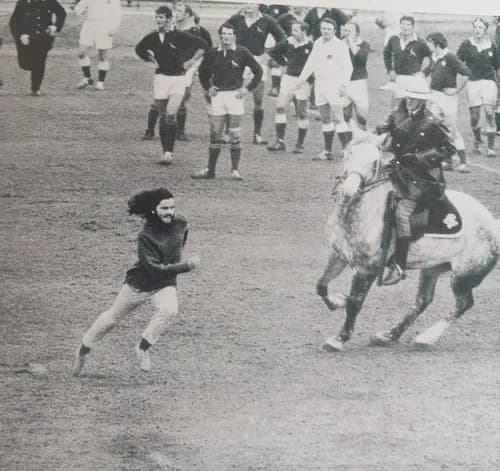
The Springboks arrived in Australia in the winter of 1971 with rugby on their minds. Seven matches. Three Tests against the Wallabies. For one of the world's great rugby nations, it was business as usual.
They walked straight into a war zone.
Long before these players pulled on the green and gold, South Africa's apartheid regime had turned its national team into a symbol. By 1971, the global campaign to isolate apartheid sport had gathered serious momentum. African nations were already threatening to boycott the 1972 Munich Olympics over Rhodesia and South Africa. That pressure had now reached Australia's shores.
Anticipating the chaos, Australian authorities threw up barbed-wire fences around major venues. Police escorts shadowed the team bus at every turn. Players later described hotel lobbies ringed by security, stadiums that felt closer to military compounds than sporting grounds.
This was no longer just a rugby tour. It had become a national argument about whether sport could ever truly stand apart from politics - and the answer was growing painfully clear.
Barbed Wire, Tear Gas, and Three Tests
The Matches Under Siege
On the field, the Springboks were ruthless. South Africa swept the Test series 3 - 0, but the scorelines tell only half the story.
The first Test in Sydney unfolded behind heavy fencing and a wall of mounted police. The second, in Brisbane, saw running battles between demonstrators and officers outside the ground. The third, back in Sydney, played out under similar siege conditions.
Inside the grounds, crowds were sparse by Springbok standards - a visible sign of how far the boycott campaign had reached. Outside, thousands marched under banners demanding an end to segregated sport. Tear gas drifted near turnstiles at more than one fixture. Arrests numbered in the hundreds across the tour.
Table: 1971 Springboks Australian Tour - Test Series Results
| Test | Venue | Result | Conditions |
|---|---|---|---|
| First Test | Sydney | South Africa won | Heavy fencing, mounted police |
| Second Test | Brisbane | South Africa won | Running battles outside ground |
| Third Test | Sydney | South Africa won | Security siege, sparse crowds |
📊 3 - 0 - South Africa's clean sweep of the Test series, achieved amid the most hostile sporting environment the team had ever faced.
The Players' Impossible Position
South African players insisted they had come to play rugby, not to make politics. Critics countered that representing an apartheid state was inherently political, whether they chose it or not.
Australian rugby officials defended the tour on grounds of tradition and reciprocity. Anti-apartheid groups argued that no tradition justified legitimising a regime built on racial oppression.
The split ran straight through Australian society. Unions, churches, students, and even some rugby clubs publicly opposed the tour. Others saw the protests as an attack on their game - a sport they loved being dragged into a fight they never asked for.
The Legacy: Sport's Reckoning
The 1971 tour didn't end apartheid. But it showed the world something important - that sport could be a pressure point, and that the cost of hosting a segregated team was rising fast.
Australia's own rugby community was forced to confront questions it had dodged for years. The barbed wire around those grounds became the era's defining image: a game quarantined from the society watching it.
Five decades on, the tour reads less like a footnote and more like a turning point. It foreshadowed the sporting boycotts that helped isolate South Africa through the 1970s and 1980s, culminating in the country's readmission to world rugby in 1992. For the men who played under police protection in 1971, the memory is complicated. For everyone else, it remains a reminder that no whistle ever blew loudly enough to drown out the world outside the fence.