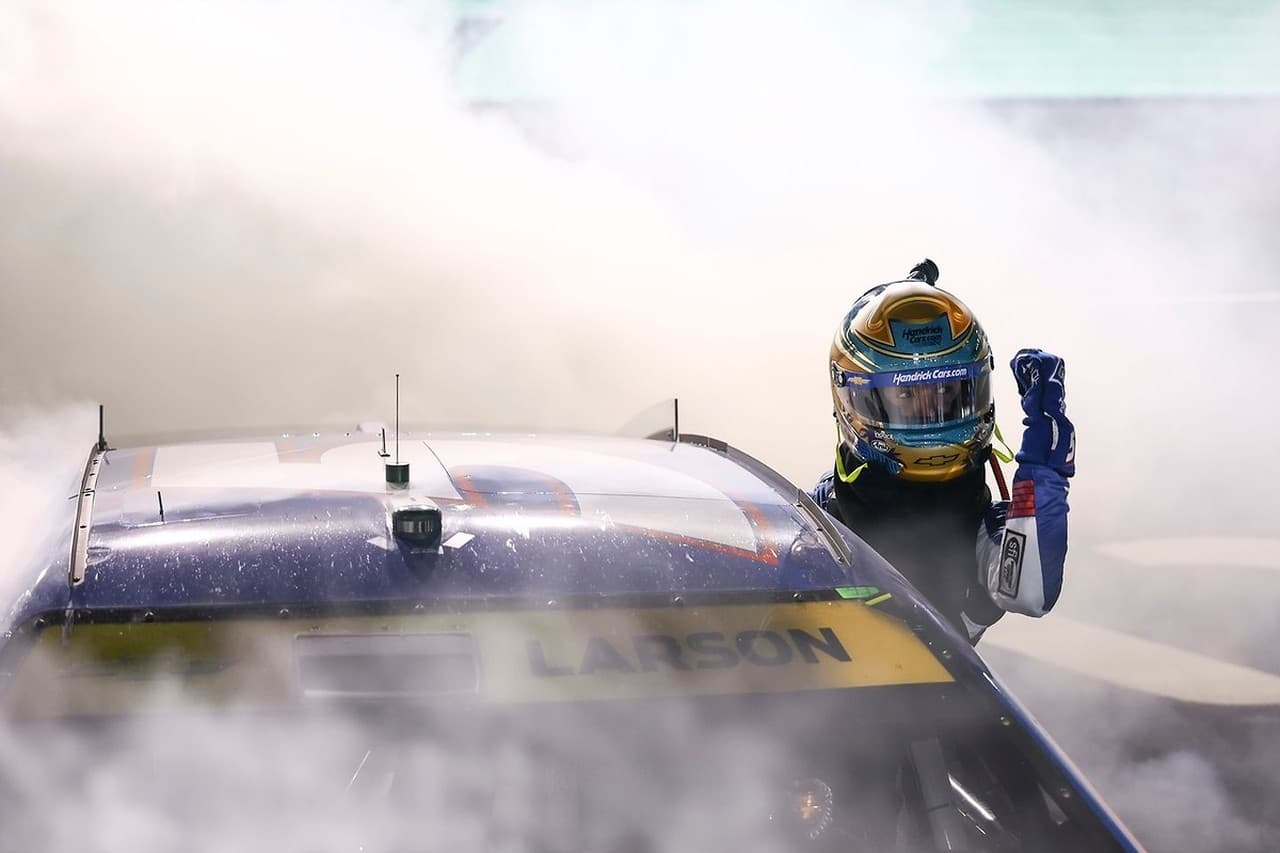
Kyle Larson has never been shy about his horsepower obsession. For years, he has been one of the loudest voices in the NASCAR garage pushing for a return toward 900-plus horsepower. Again and again, he has argued that the current 670 hp package dulls the racing product and flattens the skill gap between drivers. So when Larson publicly credits NASCAR for listening on horsepower, that is not a small thing. It is a rare olive branch from the sport's most persistent critic on the topic.
And in true Larson fashion, he took that credit and used it as a launching pad. Since NASCAR introduced the 670 hp package in 2022, Larson has framed his push around one core belief: more power means better racing. Higher horsepower, he contends, creates off-throttle time, forces drivers to manage tire wear with their right foot, and rewards the most talented wheelmen instead of the ones who simply hold it wide open. That argument has echoed through driver council meetings and media availabilities for years. So when Larson says NASCAR got the response right, fans should read it as a signal - real movement, not just polite talk. His advocacy history says it all: this is a driver who measures progress in dyno numbers, and he is keeping score.
Now here is the part Larson wants everyone to hear clearly: progress is progress, but it is not the finish line. His message lands with a built-in "but." Any horsepower the package gains is welcome, yet Larson believes the ceiling remains too low - and he has no plans to soften that stance just because NASCAR made a move. The tension is the story. Larson is praising the sanctioning body and pressuring it at the same time, playing the role of constructive critic rather than complainer. He does not want credit for being right; he wants laps that feel right. When Larson credits NASCAR's horsepower response while immediately wanting more, he is doing exactly what a fan-first star should do - holding the sport accountable to the on-track product.
> 📊 ~900+ hp - Larson's publicly stated target for the Cup Series package, roughly 230 horsepower above the 670 hp baseline introduced in 2022.
That gap is the whole debate in one number. Larson's core reasoning has never wavered: better racing, clearer separation of driver skill, and rewards for the best. A higher-horsepower car punishes mistakes and rewards precision, and Larson has argued that fans can see the difference on Sundays even if they cannot explain the physics.
| Element | Current Package | Larson's Target |
|---|---|---|
| Baseline horsepower | 670 hp | ~900+ hp |
| Core argument | Manageable, spec-friendly racing | Off-throttle time, tire management, skill differentiation |
| Public stance | Credits NASCAR's response | Wants further increases |
What Comes Next: Pressure Builds on NASCAR
This is the dynamic NASCAR now has to manage: drivers praising progress while pushing for the next step. It is a pattern that repeats every time the sport opens a package discussion - drivers say thank you with one hand and knock on the door with the other. For fans, the stakes are tangible. More horsepower would mean more off-throttle time, more tire falloff, more comers and goers across a long run, and more moments where the best driver in the best car simply has to outdrive the field. That is the on-track product fans actually watch, and it is why the horsepower conversation refuses to die no matter how many meetings it survives.